WEAVING BLACK

Weaving Black translates the Nishijin motif of flowing water—a symbol of change—into an installation of sound, water, and light. Drawing on his family’s tradition of weaving, Masahiko Takeda treats sound as a material that takes on structuring qualities through layering, rhythm, and repetition. The act of weaving shifts from the textile realm to an interplay of sound, space, and image.
Weaving Black is inspired by the traditional Nishijin textile motif “Ryūsui” (flowing water). This motif, used for centuries in kimono and obi patterns, symbolizes continuous change and natural cycles.
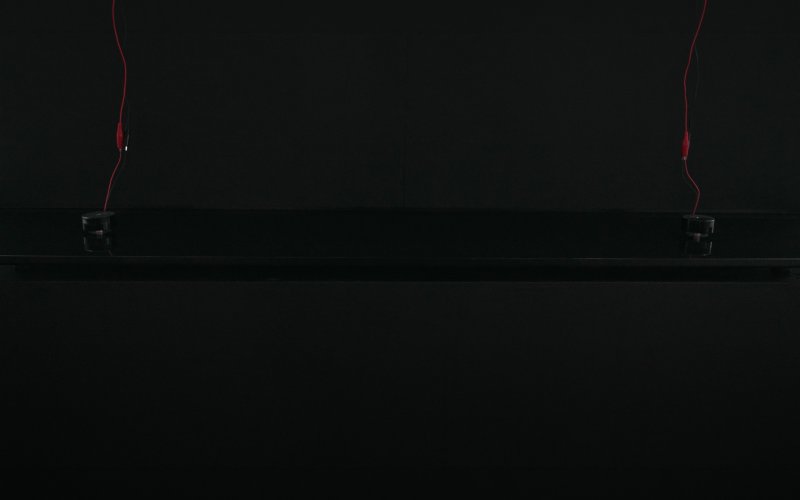
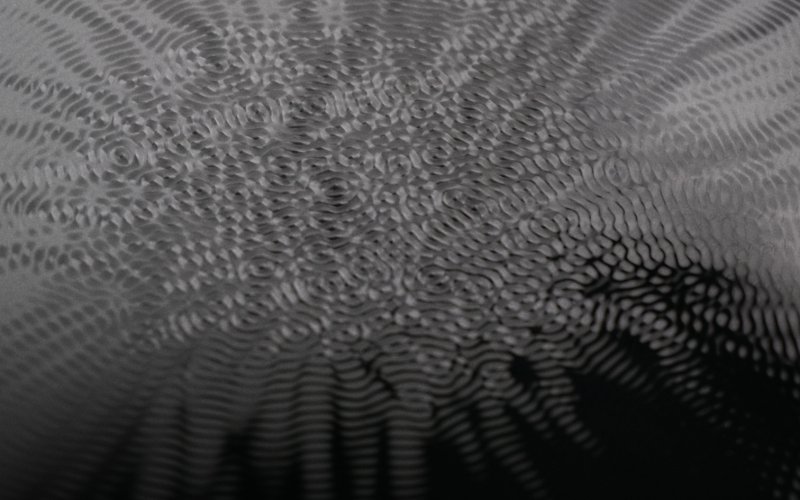
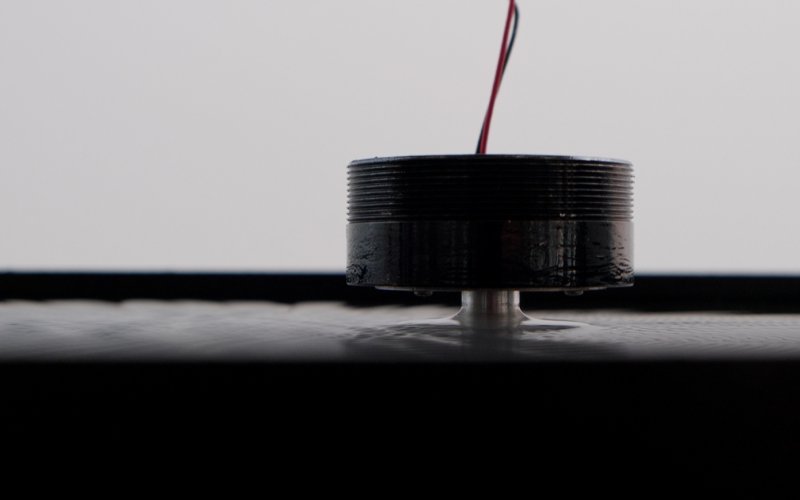
At the heart of the installation, with its primary elements of sound, water, and light, lies the idea of transformation: Vibrations from multi-layered woven sound structures interact with water surfaces distributed throughout the space, which serve as sensitive membranes. The resulting “water images” remain unstable and processual—they constantly change depending on frequency, intensity, and spatial arrangement; at the same time, they make the distribution and structuring of acoustic processes in the space visible.
The installation intertwines acoustic, visual, and material levels and understands resonance as a form-generating principle. Sound appears here not only as an auditory phenomenon, but as spatial movement and a temporal structure.
A biographical point of reference lies in the Nishijin weaving tradition of the artist’s family. There, they produced exclusively black obi, known as kurotomo—a component of women’s mourning attire. Weaving, understood as the structuring interconnection of individual elements, forms the conceptual starting point.
Against the backdrop of being unable to continue this artisanal tradition, Masahiko Takeda develops a different form of “weaving.” In Weaving Black, sound itself becomes the material, taking on structuring properties through layering, rhythm, and repetition. The gesture of weaving shifts from the textile realm into an immaterial field and is redefined as a process of vibration and resonance.
Weaving Black combines traditional references with contemporary media practice. The principle of weaving is preserved but transferred to a different material system. Transformation as a central motif manifests itself between the material and the immaterial, between artisanal practice and installation-based arrangement, between stable form and continuous change.