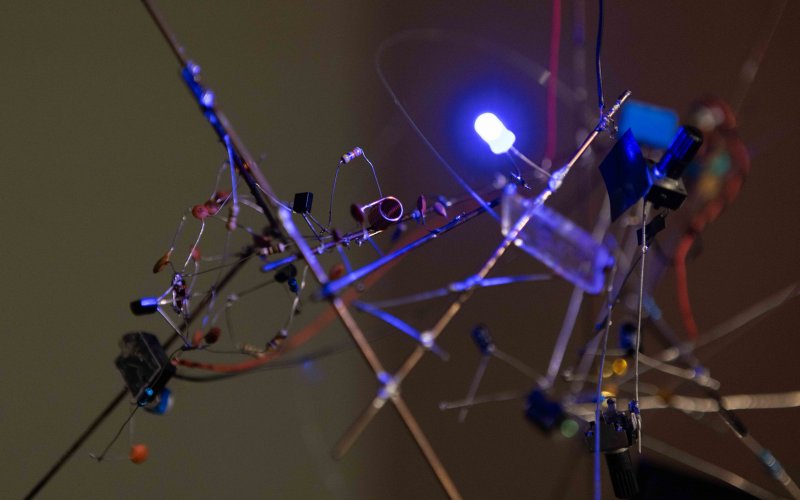
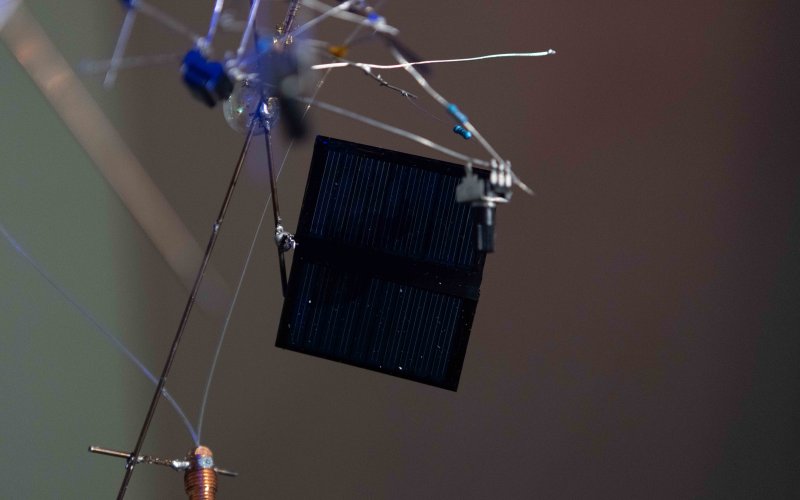
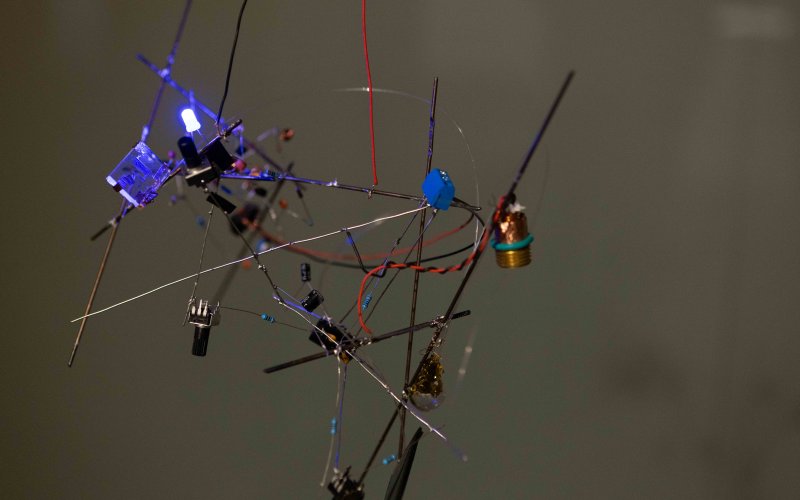
Picocosmos (2024) is a live-transmission sculpture that broadcasts the sound of single photons at 87.7 MHz to the universe. But what exactly is a single photon? In search of understanding, Edy Fung asked physicists to sketch out what a photon looks like. According to quantum mechanics, the moment a photon is emitted—when an electron falls from its excited state back to its ground state—it is considered random, inherently spontaneous, and unpredictable. The behaviour of single photons offers immense potential for applications like quantum cryptography and key distribution. Nevertheless, photons suitable for quantum communication are extremely ephemeral, existing on picosecond timescales before being lost.
The future data of our civilization may be recorded on these fleeting memory units, perhaps reiterated through quantum repeaters. Picocosmos conceives translating picosecond-old photons into radio pulses—searchable, durable, and capable of travelling vast distances between planets and galaxies. This self-built sculptural device adds a new dimension to satellite-based quantum communication networks. Quantum memory from single photons at 894 nm, stored in warm atomic cesium-133 vapour (in conjunction with atomic clocks), are transduced into an audio signal, which is then encoded onto an FM radio signal and broadcast openly across the universe at frequencies between 30 and 300 MHz. On the receiving end, information about the photons can be retrieved, along with their sound—something that cannot otherwise travel or be accessed in outer space. Can we dream of democratizing quantum computing and communication, much like radio technology flourished through grassroots movements and communities 100 years ago?