
Solar Crawlers
Termine:
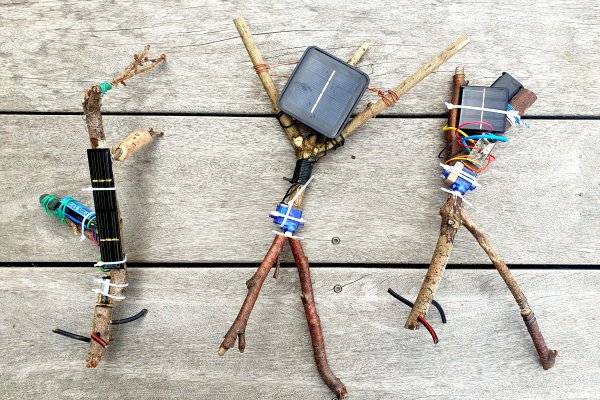
Solar crawlers are simple, small, off-grid robots made from recycled electronic parts and wood. They are activated or charged by sunlight and release their energy in the form of mechanical movement. Despite their quirky appearance, they are resilient and move slowly forward. They are an experiment in developing a post-capitalist, solar-punk aesthetic and promoting a scarcity-oriented working methodology.
The crawlers are inspired by Gijs Gieske's wandering branch-like creations.1 While Gieske's creatures are visually unique due to the use of found wood, they all have the same uniform circuit board made from new electronic parts, which can be assembled in one of Gieske's workshops to construct them. I wanted to take this even further out of the maker's comfort zone: I limited myself to using only electronic waste that I had found in my surroundings. In this way, each crawler has a different circuit and therefore behaves in new ways in response to the sun or its absence: one moves when its battery is already charged in the sun and stops charging in the shade; another only moves in the sun, etc.
“All functioning technologies are the same. All defective technologies are defective in their own way.”
Our technological environment overlooks and ignores the defective, the botched, the imperfect, the asymmetrical, the used, the non-cloud-based, the non-continuous, the non-connected. Crawlers, on the other hand, represent the potential to engage with technology in a non-mainstream way, both visually and in terms of how they function: they are not designed to be streamlined and symmetrical, to respond perfectly, and to keep their mechanics invisible. They are not intelligent, and there is no app you can install to operate them. This rawness and lack of scalable reproducibility are based on the advantage that they do not rely on the exploitation of people and natural resources for their operation.
Solarpunk, a trend in speculative fiction and visual culture, is understood as a collection of hopeful visions of a sustainable future, in contrast to the insurmountable crisis of human civilization we call the Anthropocene. Solarpunk depicts the nature and culture of a speculative future as ultimately bright, gentle, and high-tech, with biomorphic Art Deco-style architecture. But such a vision is likely to be reserved for those who can afford it, just like the apocalypse survival bunkers of the super-rich. My work aims to redefine solarpunk in terms of political engagement and material practice, and to achieve this, I will use the term “solar_punk” to refer to a more literal understanding. The crawlers are part of this effort.
Low-Tech Magazine, an important inspiration for my work, teaches us to live with renewable technologies in a mindset that disregards the standard of continuous services—i.e., continuous connection and always-available energy—and to adjust to the fact that these are transient, just like crawlers.
One of the more personal aspects that motivated me to develop the Crawlers is my recent experience with a semi-permanent physical disability. Watching the Crawlers as they unobtrusively but persistently attempt to overcome obstacles reminds me of my own recent experience with disability: my body's functionality was similarly limited compared to that of people without disabilities. My repeated efforts to move around in the world required the resilience that the crawlers seem to display in the world of perfect-looking smart technologies.


